


Two years, three months, and eight days since my last blog post. Yet every once in a while someone still happens across this place and leaves a comment. Every time I received one those e-mails, part of me missed this little outlet for semi-anonymous self-reflection and sharing, and figured eventually the time would be right to return. Like the Prodigal Son, I've done my share of wallowing in the mud and drinking from cisterns that do not satisfy one's inner thirst. And like him and St. Francis, I finally came around to embracing my Father in a new and refreshing way.
While I never left the Church, at times serving Mass was nothing more than a chore to keep my body occupied while my mind questioned the existence of God. Much of the time God so graciously gave me was given over to withdrawing into a paralyzing inner isolation, asking all the big life questions, intimidated to look inside my soul... not seeing much there and vainly grabbing onto any experience that distract me from the real work at hand... like walking into a mess that you have no idea how to begin cleaning... so you procrastinate with meaningless tasks... until you finally do one small thing to make it right that leads to doing another bigger thing...
Thankfully that mess is (mostly) cleaned up... I've done a healthy bit of introspection recently, especially when I noticed that the past five years were blurring together. Plus, watching the current Terrence Malick film, "Tree of Life," spurred me into facing some demons once again, which hasn't been fun, but it is necessary if they'll ever be put to rest.
I reckon that's about all for now... after seeing "Tree of Life" again, it'll definitely be post-worthy material.
Showing posts with label redemption. Show all posts
Showing posts with label redemption. Show all posts
04 July 2011


30 April 2007
One thing I love about Confession...
...is that it's one place I never have to be pretend to be holy or righteous.
Sometimes, especially when you feel that ickiness of sin all over your soul, you almost feel like you're lying to yourself and everyone around you by actually going to church or saying grace. It's so refreshing to have a sacred place where we can be washed clean once again, knowing with full confidence that although, like the Prodigal Son, we have sinned against Heaven and against you, Christ created a place where Heaven and earth meet -- a sacrament -- to continually reconcile His children to one another and Himself.
To use a little Evangelical language, what a wonderful and awesome gift it is to have Jesus as a personal accountability partner! Of course, the sacrament of Reconciliation is so much more effective than the Protestant practice of accountability partners. When you are accountable to just another sinner, it's easy to bend the truth, tell a little white lie, or a big lie. Of course, you can lie to Jesus too, but you can't fool Him and you know it.
And even more, you get to hear Jesus personally say to you (through the priest) those redeeming words, "I forgive you of all your sins in the name of the Father, and of the Son, and of the Holy Spirit." Having confessed your sins with a contrite heart, you can walk away knowing with full confidence that your soul is free of the stain of sin -- if it only lasts for a short time, it's a good feeling regardless.
I never got that feeling from any other accountability partner :)
Sometimes, especially when you feel that ickiness of sin all over your soul, you almost feel like you're lying to yourself and everyone around you by actually going to church or saying grace. It's so refreshing to have a sacred place where we can be washed clean once again, knowing with full confidence that although, like the Prodigal Son, we have sinned against Heaven and against you, Christ created a place where Heaven and earth meet -- a sacrament -- to continually reconcile His children to one another and Himself.
To use a little Evangelical language, what a wonderful and awesome gift it is to have Jesus as a personal accountability partner! Of course, the sacrament of Reconciliation is so much more effective than the Protestant practice of accountability partners. When you are accountable to just another sinner, it's easy to bend the truth, tell a little white lie, or a big lie. Of course, you can lie to Jesus too, but you can't fool Him and you know it.
And even more, you get to hear Jesus personally say to you (through the priest) those redeeming words, "I forgive you of all your sins in the name of the Father, and of the Son, and of the Holy Spirit." Having confessed your sins with a contrite heart, you can walk away knowing with full confidence that your soul is free of the stain of sin -- if it only lasts for a short time, it's a good feeling regardless.
I never got that feeling from any other accountability partner :)
06 May 2006
Psalm 116
I've been diggin' the Verbum Domini podcast lately... it's just a 3-5 minute recording of each day's Scripture readings, which I think is pretty genius. Today's Psalm reading is from 116 and I liked it, so I'm gonna post part of it here since this is my blog and I can do whatever I want with it. Booya.
I've just been thinking about how nobody becomes a Christian until they've faced their sins and admitted their need for redemption. Usually when we look into our past and remember the stupid crap we've done (or maybe stuff we don't remember at all...), we regret it and almost wish we could somehow go back and change what's already happened. Of course, I'll probably never grasp how God can forget all our sins like snapping your fingers, but I don't necessarily wish I could change anything in the past. Not because I'm proud of those things, but because I wonder if I would've truly humbled myself before Christ otherwise.
One part of the Lutheran liturgy that I always enjoyed was the Hymn of Praise. I've never heard it in a Catholic church, but the words are beautiful. Best I remember, the liturgy begins with a confession of sins and this hymn follows it after the pastor pronounces the forgiveness of everyone's sins (it's very similar to the Sacrament of Confession, but it's not sacramental):
This is the feast of victory for our God. Alleluia.
Worthy is Christ, the Lamb who was slain,
Whose blood set us free to be people of God.
Power, riches, wisdom, and strength,
And honor and blessing and glory are his.
This is the feast of victory for our God. Alleluia.
Sing with the people of God
And join in the hymn of all creation;
Blessing and honor and glory and might
Be to God and the Lamb forever. Amen.
This is the feast of victory for our God.
For the Lamb who was slain has begun his reign. Alleluia. Alleluia!
I love the Lord because he has heard my voice and my supplications.
Because he inclined his ear to me, therefore I will call on him as long as I live.
The snares of death encompassed me;
the pangs of Sheol laid hold on me;
I suffered distress and anguish.
Return, O my soul, to your rest;
for the Lord has dealt bountifully with you.
For thou hast delivered my soul from death,
my eyes from tears,
my feet from stumbling;
I walk before the Lord in the land of the living.
What shall I render to the Lord for all his bounty to me?
I will lift up the cup of salvation and call on the name of the Lord
Precious in the sight of the Lord is the death of his saints.
O Lord, I am thy servant;
I am thy servant, the son of thy handmaid.
I will offer to thee the sacrifice of thanksgiving and call on the name of the Lord.
Praise the Lord!
I've just been thinking about how nobody becomes a Christian until they've faced their sins and admitted their need for redemption. Usually when we look into our past and remember the stupid crap we've done (or maybe stuff we don't remember at all...), we regret it and almost wish we could somehow go back and change what's already happened. Of course, I'll probably never grasp how God can forget all our sins like snapping your fingers, but I don't necessarily wish I could change anything in the past. Not because I'm proud of those things, but because I wonder if I would've truly humbled myself before Christ otherwise.
One part of the Lutheran liturgy that I always enjoyed was the Hymn of Praise. I've never heard it in a Catholic church, but the words are beautiful. Best I remember, the liturgy begins with a confession of sins and this hymn follows it after the pastor pronounces the forgiveness of everyone's sins (it's very similar to the Sacrament of Confession, but it's not sacramental):
This is the feast of victory for our God. Alleluia.
Worthy is Christ, the Lamb who was slain,
Whose blood set us free to be people of God.
Power, riches, wisdom, and strength,
And honor and blessing and glory are his.
This is the feast of victory for our God. Alleluia.
Sing with the people of God
And join in the hymn of all creation;
Blessing and honor and glory and might
Be to God and the Lamb forever. Amen.
This is the feast of victory for our God.
For the Lamb who was slain has begun his reign. Alleluia. Alleluia!
06 April 2006
Did St. Francis Die From an STD?
Francis died at only 45 years of age. Later in life his vision slowly deteriorated, sometimes to the point of complete blindness. Due to the pain in his eyes, Brother Elias insisted he seek treatment. So they traveled to Rieti and Francis underwent the excruciating cauterization procedure, but his sight never improved. While nobody can look back and diagnose whether Francis simply died from years under harsh living conditions, an STD, or some other kind of disease, we do know that before turning his life over to God he pretty much indulged in every kind of pleasure life offered. To put it simply, Francis had a lot of sex. Now, considering both the general lack of knowledge about STDs and the inability to protect oneself (outside of abstinence), I can't imagine how anyone could get away with even a moderately sexually active lifestyle with catching something. And at least one common STD, Cytomegalovirus, can result in blindness. Considering his relatively young age at death, you can't rule out the possibility.
Of course, we'll never know for sure and ultimately it doesn't matter, but I do feel that if it is true, such a death only makes Francis' story that much more dramatic and relevant in an age of widespread sexual confusion and promiscuity. It's also a powerful testimony to Francis' redemption from his old "life" to eternal life in Christ. Francis could have died for the world and all the temporal pleasures it offered him, but he chose Christ and died for Christ, teaching his brothers by word and example right to the very end. And perhaps an early death was God's gift to Francis, to finally be taken from this world and into Heaven.
Of course, we'll never know for sure and ultimately it doesn't matter, but I do feel that if it is true, such a death only makes Francis' story that much more dramatic and relevant in an age of widespread sexual confusion and promiscuity. It's also a powerful testimony to Francis' redemption from his old "life" to eternal life in Christ. Francis could have died for the world and all the temporal pleasures it offered him, but he chose Christ and died for Christ, teaching his brothers by word and example right to the very end. And perhaps an early death was God's gift to Francis, to finally be taken from this world and into Heaven.
04 March 2006
Haunted by the Saints
The saints have really been challenging me lately. Reading about St. Francis has me thinking a lot about how much he and his brothers sacrificed to live the Gospel as best as they knew how. These guys embraced the poor. When St. Francis heard the Gospel reading at Mass, it was as though God were speaking personally to him. Christ says to each of us, Amen, I say to you, whatever you did for one of these least brothers of mine, you did for me. What if we took those words seriously? Do we really see Jesus in the "least of these" in our society? When we have a conversation with a homeless person, we're talking with Jesus; when we look them in the eye, we're looking Jesus in the eye. We talk about "experiencing God" through contemporary worship, and while that has it's place, it seems like for most Christians that's where the God experience ends. I feel haunted by the lives of people like St. Francis because I know more people are called to similar lives of sacrificial love for God and neighbor, but it's such a radical calling that they opt for a safer road.
I've also been learning about a different saint every day with the Saint of the Day e-mail. It's difficult for me to ignore the chasm between their lives -- the sacrifices they made out of their deep love for God and desire for others to follow Christ -- and my own life. Of course, I don't want to throw a little pity party for my sinful self. That would be worthless. But I can't ignore that God is starting to prepare me to abandon everything for Him in a similar manner. Some mornings I wake up and the first thought in my head is, "You don't seriously want to become a priest, much less a Franciscan. That's ridiculous."
Exactly... such a calling was too ridiculous even for St. Francis, but God is faithful every step of the way. "But God," by the way, happens to be one of my favorite two words in the Bible. This short phrase occurs 41 times (at least in the NASB translation)...
But God remembered Noah ... and the water subsided. (Genesis 8:1)
But God said to Abraham, "Do not be distressed because of the lad and your maid; whatever Sarah tells you, listen to her, for through Isaac your descendants shall be named. (Genesis 21:12)
But God will redeem my soul from the power of Sheol,For He will receive me. (Psalms 49:15)
My flesh and my heart may fail, But God is the strength of my heart and my portion forever. (Psalms 73:26)
Who can forgive sins, but God alone? (Mark 2:7 and Luke 5:21)
You are those who justify yourselves in the sight of men, but God knows your hearts... (Luke 16:15)
But God raised Him up again, putting an end to the agony of death, since it was impossible for Him to be held in its power. (Acts 2:24)
But God raised Him from the dead... (Acts 13:30)
But God demonstrates His own love toward us, in that while we were yet sinners, Christ died for us. (Romans 5:8)
You know how certain words from a sermon will stick in your head for months? I keep going back to something one of the priests at the Youth 2000 retreat said about our expectations in praying for miracles. "God isn't going to raise someone back from the dead," with which he followed after a short pause, "in all likelihood." Isn't is awesome that we believe in the one God who holds power over sin and death, that even the one miracle that most would consider impossible -- well, not necessarily. Throughout history, God has intervened in the bleakest of times and revealed His glory. We can go before our Lord in full confidence that no request is too great -- nor too petty -- no matter how weak our faith might feel, for nothing will be impossible with God.
I've also been learning about a different saint every day with the Saint of the Day e-mail. It's difficult for me to ignore the chasm between their lives -- the sacrifices they made out of their deep love for God and desire for others to follow Christ -- and my own life. Of course, I don't want to throw a little pity party for my sinful self. That would be worthless. But I can't ignore that God is starting to prepare me to abandon everything for Him in a similar manner. Some mornings I wake up and the first thought in my head is, "You don't seriously want to become a priest, much less a Franciscan. That's ridiculous."
Exactly... such a calling was too ridiculous even for St. Francis, but God is faithful every step of the way. "But God," by the way, happens to be one of my favorite two words in the Bible. This short phrase occurs 41 times (at least in the NASB translation)...
But God remembered Noah ... and the water subsided. (Genesis 8:1)
But God said to Abraham, "Do not be distressed because of the lad and your maid; whatever Sarah tells you, listen to her, for through Isaac your descendants shall be named. (Genesis 21:12)
But God will redeem my soul from the power of Sheol,For He will receive me. (Psalms 49:15)
My flesh and my heart may fail, But God is the strength of my heart and my portion forever. (Psalms 73:26)
Who can forgive sins, but God alone? (Mark 2:7 and Luke 5:21)
You are those who justify yourselves in the sight of men, but God knows your hearts... (Luke 16:15)
But God raised Him up again, putting an end to the agony of death, since it was impossible for Him to be held in its power. (Acts 2:24)
But God raised Him from the dead... (Acts 13:30)
But God demonstrates His own love toward us, in that while we were yet sinners, Christ died for us. (Romans 5:8)
You know how certain words from a sermon will stick in your head for months? I keep going back to something one of the priests at the Youth 2000 retreat said about our expectations in praying for miracles. "God isn't going to raise someone back from the dead," with which he followed after a short pause, "in all likelihood." Isn't is awesome that we believe in the one God who holds power over sin and death, that even the one miracle that most would consider impossible -- well, not necessarily. Throughout history, God has intervened in the bleakest of times and revealed His glory. We can go before our Lord in full confidence that no request is too great -- nor too petty -- no matter how weak our faith might feel, for nothing will be impossible with God.
28 January 2006
Who is the Richest Man in Assisi?

[Editors note: There was originally a post before this, but in the wisdom of time did not find that one to be all that important or engaging. This was the second post, so I promoted it become the first post since it just makes sense that way. I left a note where the original content of this post begins, which I wanted to save since it I wrote it shortly after first learning about St. Francis' story.]
Who is the richest man in Assisi? My blog title is partly an allusion to a parable on financial wisdom by George S. Clason: "The Richest Man in Babylon." I read it years ago in high school, at a time when I devoured just about anything related to personal finance and investing, and even free-lanced a series of articles on the book. Babylon is one of the world's earliest civilizations. They pioneered beer brewing, which I consider as good a benchmark of civilized activity as any. The simple Babylonian economy allows the author to use simple concepts that a layperson can use to better understand today's more complex financial world.
Which brings us to St. Francis, growing up in 12th Century Italy, when international trade, corporate structures, and a rising middle-class were forming the earliest budding seeds of today's modern economy. Francis' father, Pietro Bernadone, was a garment merchant and regarded as the wealthiest man in Assisi. Probably no Medici, to be sure, but up there on the food chain regardless. And since Francis would inherit his father's business and fortune, I call him the "richest man in Assisi."
Of course, not just for that reason -- for if anyone wrestled with God, Francis wrestled. And eventually things came to a head as Francis fell in love with Lady Poverty, coming to view the family business and wealth as pesky mistresses he wanted nothing to do with. In renouncing his natural father's inheritance, he declared, "From now on, I shall only say 'Our Father, who art in heaven,'" embracing his bishop without a stitch of clothes on (imagine that happening today! Assisi apparently didn't have any lawyers :) Thus, Francis exchanged an earthly inheritance for an eternal one, and dying some years later on a cold dirt floor -- naked again, save for a blanket -- it is not Pietro we remember 800 years later, but this man whom thousands of Franciscans emulate around the world, who is often regarded as the most Christ-like of saints, who personally loved his neighbor, whether he find him to be a sickly leper or the Sultan of Egypt.
Many of the issues Francis faced are still relevant today. He is one of the most famous saints, yet one of least known. I regard him as my patron saint, as Francis of Assisi is the Confirmation name I chose on April 15, 2006. And this blog is essentially my thoughts on faith and modern life in light of my esteem for St. Francis.
[Below is the original content of this post, sharing my brief version of Francis' biography when I just learned about him.]
S
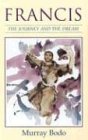 peaking of books, one of the Franciscans who lives at St. Anthony's gave me a book titled Francis: The Journey and the Dream by Murray Bodo. I guess you'd describe it as a creative account of St. Francis' life. Instead of just telling the facts about his life, it speculates more about his struggles discerning God's will in the face of rejection by relatives and friends. It should make for good meditation.
Having everything he could care for, Francis reveled in the pleasures of life and tended not to be very studious at school. Even those he exhibited sharp business skills, making him the natural candidate to inherit the family business and surely surpass his father in wealth, his dream was to be a knight. He enthusiastically enrolled with an army fighting for Pope Innocent III and was two days into the journey to battle, but God...
A voice in the night instructed Francis to return home and ponder a little more the vision God had given him. No doubt this was frustrating. At some time or another, we have all felt confident of God's will for our lives only to learn that wasn't it at all. But this vision was mysterious if it didn't mean fighting as a knight. In Murray Bodo's description of this vision, Francis "was led into the great hall of a dazzling Palace, where a radiant Princess-Bride held court. The walls were covered with shields and trophies of battles won. And when he asked aloud who the Lord of the castle was, a voice sang out: 'It's the high court of Francis Bernardone and his followers.'" God instructed Francis to abandon the military and return home, where he would be told what to do.
While Francis continued to party with his old friends, God had drawn his heart to a higher calling.
 While riding on horseback one day, he suddenly came upon a repulsive leper. At first, he retreated in disgust, but he couldn't pass him by. Instead, he dismounted the house and embraced the leper, then gave him all his money. Surely, failing to embrace this poor leper would have been a failure to embrace Christ himself. Indeed, it was in the crumbling chapel of St. Damien that Francis heard Christ speak from the cross, commanding him, "Go, rebuild my church, which you can see has fallen into ruins."
In his saintly zeal, Francis started the work of rebuilding this chapel. It was literally falling apart, after all. He immediately went and sold some of his father's inventory of cloth and one of his horses to raise money for the church. Naturally, his father was angry, and Francis escaped to a cave for a month to avoid him. Upon returning to the city, a crowd pelted Francis with mud and stones, mocking him as a madman. Pietro forced him home, beat him, and locked him bounded in a dark closet.
While the gold was recovered since the priest at St. Damien refused to accept it, Pietro also wanted Francis to forgoe his inheritence. Brought before the bishop, Francis -- who was once destined in the world's eyes to inherit all the wealth Assisi could offer -- stripped himself of his clothes and handed them to this father, declaring, "I have called you my father on earth. From now on, I desire to say only 'Our Father, who art in heaven."
 Francis continued working on the restoration of St. Damien's and two abandoned chapels near Assisi, begging for stones and personally putting them in place, while also caring for the lepers. Apparently he didn't leave much room for interpretation when God's Word seemed to speak directly to him. After hearing the Gospel message of Jesus instructing the disciples to carry no gold or silver, shoes, nor a staff for the journey, but to go out preaching repentance and announcing the Kingdom of God, Francis rid himself of what little he still owned. Now he wore merely a coarse, brown tunic tied around him with a knotted rope -- the clothing of the poorest peasants. Out in the countryside, he preached penance, brotherly love, and peace. Francis soon began attracting followers who shed everything they owned to take up a life of service and preaching the Gospel.
This movement, eventually developing into the Franciscan Order, did rebuild the Church -- not so much physically, but spiritually. In the midst of widespread corruption within the Church hierarchy, God used Francis to inspire Christians to lives of sacrificial love for God and neighbor. And that mysterious vision of shields and trophies wasn't for earthly battles won as a knight, but for the thousands of souls delivered from darkness by Francis and his followers.
In addition to the ordes, he was an active missionary travelling even as far as personally visiting the Sultan of Egypt during the midst of the Crusades. Francis also started the tradition of building Nativity scenes and was the first person to receive the stigmata. He died naked on the bare ground of a hut, covered only by a borrowed cloth, but had gained the favor of God and even the same citizens of Assisi who once stoned him as a madman. Therefore, I call him the richest man in Assisi.
Subscribe to:
Posts (Atom)